
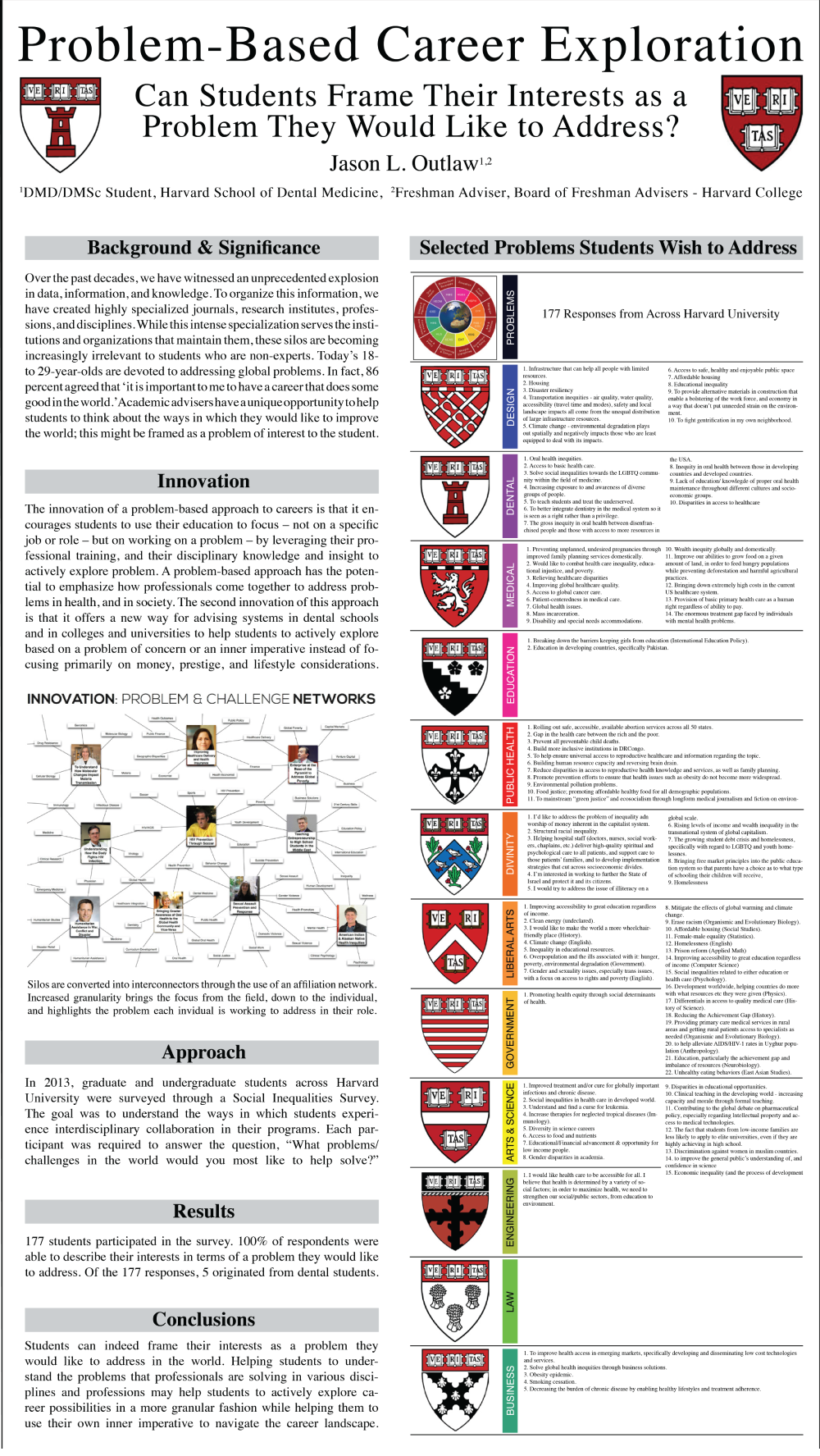
Can Students Frame Their Interests as a Problem They Would Like to Address?
DMD/DMSc Student, Harvard School of Dental Medicine
Freshman Adviser – Board of Freshmen Advisers, Harvard College
Background & Significance Over the past decades, we have witnessed an unprecedented explosion in data, information, and knowledge. To organize this information, we have created highly specialized journals, research institutes, professions, and disciplines. While this intense specialization serves the institutions and organizations that maintain them, these silos are becoming increasingly irrelevant to students who are non-experts. Today’s 18- to 29 year-olds are devoted to addressing global problems. In fact, 86 percent agreed that ‘it is important to me to have a career that does some good in the world.’ Academic advisers have a unique opportunity to help students to think about the ways in which they would like to improve the world; this might be framed as a problem of interest to the student.
Innovation The innovation of a problem-based approach to careers is that it encourages students to use their education to focus – not on a specific job or role – but on working on a problem – by leveraging their professional training, and their disciplinary knowledge and insight. A problem-based approach has the potential to emphasize how professionals come together to address problems in health, and in society. The second innovation of this approach is that it offers a new way for advising systems in dental schools and in colleges and universities to help students to actively explore based on a problem of concern or an inner imperative instead of focusing primarily on money, prestige, and lifestyle considerations.
Approach
In 2013, students across Harvard University were surveyed through a Social Inequalities
Survey. The goal was to understand the ways in which students experience
interdisciplinary collaboration in their programs. Each participant was required to answer
the question, “what problems/challenges in the world would you most like to help solve?”
The survey was distributed to undergraduate and to graduate students across Harvard
University.
Results
177 students participated in the survey. 100% of respondents were able to describe their interests in terms of a problem they would like to address. Of the 177 responses, 5 originated from dental students.
Conclusion Students can indeed frame their interests as a problem they would like to address in the world. Helping students to understand the problems that professionals are solving in various disciplines and professions may help students to actively explore career possibilities in a more granular fashion while helping them to use their own inner imperative to navigate the career landscape.